

Chenrezig painted by Sherab Palden Beru, a Samye Ling resident
I’ve been going to a Tibetan Buddhist temple on and off for about four years (in Florence and now in Bournemouth). The normal ‘drop-in’ sessions that I attend usually involve meditation, usually of the mindfulness type — i.e. focussing on the breath/body, an object (e.g. a flower) or a sound (e.g. singing bowl), and a talk on basic Buddhist philosophy. However, after I had been going for a while I became aware of the core Tibetan Buddhist practices, the sadhanas (spiritual paths). These are really what Tibetan Buddhism is about, and any serious Tibetan Buddhist practitioner will be regularly doing at least one sadhana.
A sadhana is basically the worship of a particular Tibetan deity, such as Green Tara (removal of obstacles), Medicine Buddha (healing) or Chenrezig (compassion). To be able to participate in the worship of the deity, you have to receive an empowerment from a lama. (I received an empowerment to do Green Tara from Gyana Vajra Rinpoche, the younger son of Sakya Trizin, head of the Sakya lineage – one of the main four schools of Tibetan Buddhism). At Kagyu Samye Ling, I was told that it was dangerous to practise these sadhana’s without such permission, and the only one that I could do without an empowerment was Chenrezig.
In my limited experience and describing very simply, the sadhana practices consist of chanting in Tibetan, including the mantra of the deity, visualising the deity and the deity’s mantra, and most powerfully of all, imagining yourself as the deity. This is interesting from the point of NLP which states that if you want to have a certain quality you must ‘act as if’ you have that quality. So if you want to be compassionate, why not imagine your self as the bodhisattva Chenrezig, the epitome of compassion?
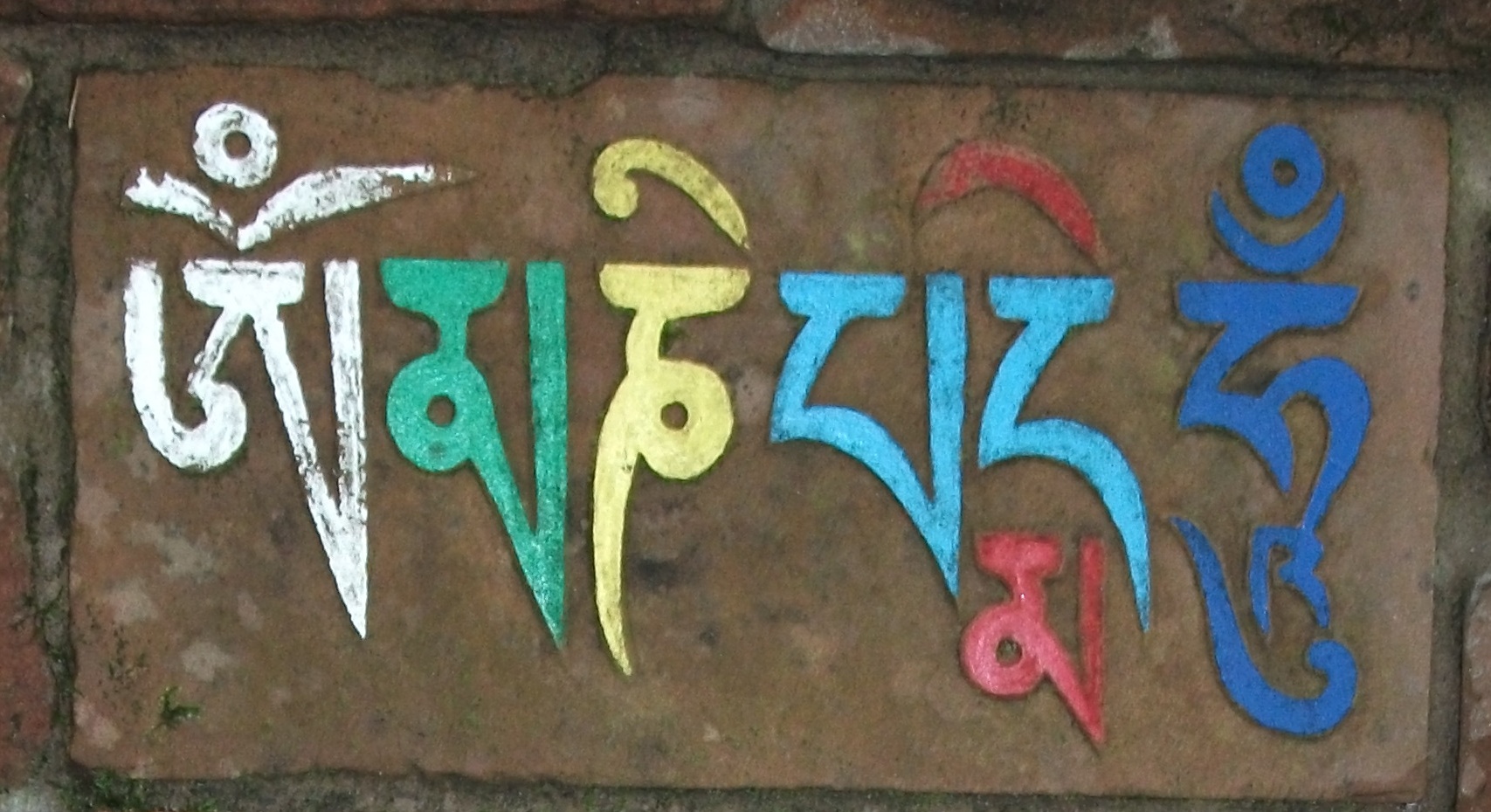
During the 10 day course on Chenrezig that I did at Samye Ling, we were encouraged to really study a picture of Chenrezig, every little detail of him, so we could imagine him vividly in our minds. We also spent hours doing calligraphy, writing the om mani padme hung mantra (the mantra associated with Chenrezig) in our best Tibetan so that we could visualise it effectively.

Buddha outside Butter House at Samye Ling
At the moment I’m not entirely how much I will incorporate Chenrezig into my daily practice. Tibetan deities still seem rather exotic, and although I’ve felt a strong link to Tibetan Buddhism for a number of years, I’ve yet to feel that about a particular deity. I also feel that the Tibetan Buddhism is in conflict with some of the yoga practices I do, particularly my daily Hindu mantra recitation. However, when I had an interview with Lama Kating at Samye Ling, he said it was very important to do practices which cultivate compassion, particularly as most traditions don’t do this. Sivananda, I guess, would say you can cultivate compassion through ‘seva’ or selfless service, but I think there’s something to be said acting directly on the mind with compassion-based meditation.
Great write. It’s so important for all of us to listen to and follow our inner truth. It’s good to be able to say “I disagree” with certain aspects or teachings, but not let that blind us to many of the other teachings that do in fact resonate with us.
Peace & grace,
~Miro
Thank you so much for reading my blog and your perceptive comment.
Charlotte