
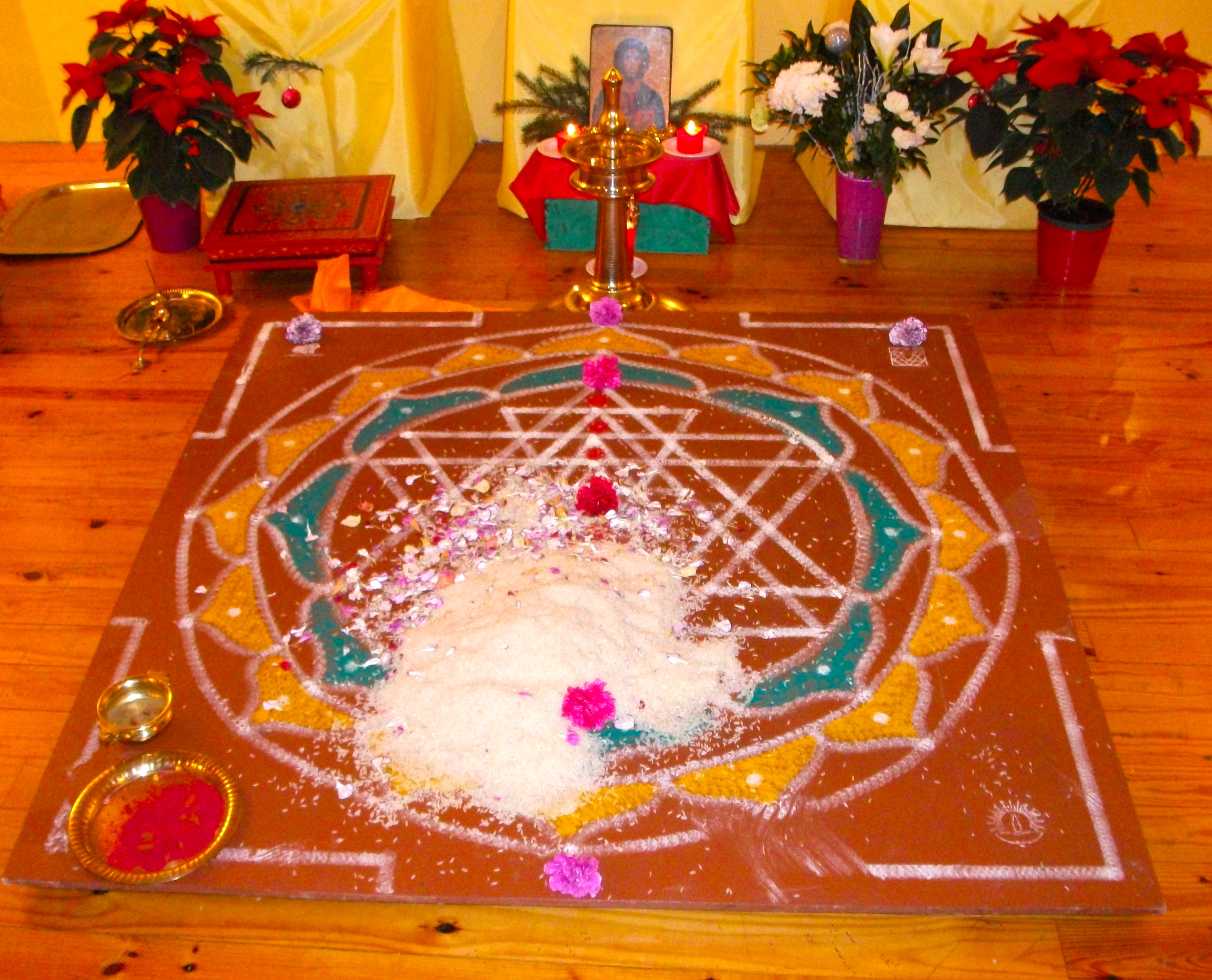
Just before Christmas, I went to the Sivananda Chateau near Orleans to do a course in Yoga and Psychology with Dr Uma Krishnamurthi. Uma was brought up in a household steeped in Hindu philosophy and spent her free time travelling to listen to gurus such as Jiddhu Krishnamurti. (“There are two ways to tell if you’re in the presence of an enlightened being,” she said. “Firstly, you will feel peaceful. Secondly, your mind will stop”). She is also well-versed in Western psychology, as she trained as a psychiatrist.
She’s an engaging speaker, illustrating useful psychological tips with jokes and stories. I’ve briefly outlined some points she made her talks, adding my own interpretation.
Happiness
Connection
To put it succinctly: Happiness is connection. In extreme states of depression, we feel totally apart from everything in creation. (“I can connect nothing/with nothing,” said T.S. Eliot in The Waste Land). For most people, this is connection to other people, but to a very small few, it’s connection to god. Connection to god is ultimately the greater happiness, as humans have a tendency to disappoint us. “Even Jesus was betrayed,” Uma counselled. “Have no expectations of anyone.”
Concentration
Concentration is also a route to happiness. In recent years, much has been made of the happiness we feel when ‘in flow’. However, the idea has been around for a long time and was expressed in Patanjali’s Yoga Sutras, believed to have been written between 100 BCE and 500 CE. In verse 1.17 the deep absorption on an object is described in four stages.
- gross – this is when you are concentrating on something, but your mind is also focussed on material objects.
- subtle – in this stage of concentration, the mind is aware of subtle objects, such as the nature of the mind itself.
- bliss – happiness comes when the mind is no longer aware of anything else but what it is focussing on.
- samadhi – at this stage the mind sees no difference between itself and what it is concentrating on.
Our natural state
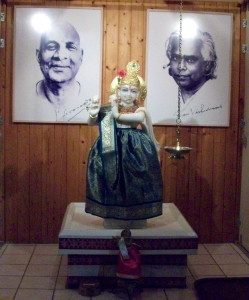
Krishna welcomes in the New Year
Uma stresses that our natural state is bliss; it’s part of our composition. The self comprises five sheaths that veil the atman, or supreme self, according to the great Vedic sage Adi Shankara in the fifteen verse of Atmabodha:
- Annamaya kosha, the material body.
- Pranamaya kosha, the energy body.
- Manomaya kosha the mind body.
- Vijnanamaya kosha the wisdom body.
- Anandamaya kosha, the bliss body.
These sheaths have been compared to the layers of an onion. We work on ourselves, through various practices such as meditation and ethical behaviour, to peel away the outer layers until we are left with the bliss body. The bliss body is what we experience in deep sleep, and in profound meditation experiences (samadhi). It’s the reason we feel so much better after a good night’s sleep.
Suffering
Suffering stems from three causes, according to the Vedic text Bhagavata Purana 7:13:31.
- adi bhautik – from physical sources. e.g. from the body.
- adi devik – from the gods. Uma interprets this as suffering as a result of past karma, although it has also been related to natural disasters.
- adhyatmik – from the mind.
Negative thinking arises from these types of suffering, which is definitely something we want to avoid, according to Uma. A yogi is someone who doesn’t suffer and who doesn’t think negatively, according to Krishna in the Bhagavad Gita (6:23 dukha-samyoga-viyogam – yoga is not getting attached to suffering). If we knew how much negative thinking damages us, we wouldn’t do it, she said. “The reason we don’t get the opportunities we think we deserve is because we are not focussed on the positive.”
Transformation

Fortunately, there are tools to transform negative emotions into positive, and she cited the ‘four aids’ outlined in Sri Aurobindo’s work Synthesis of Yoga:
- sastra – studying scriptures of truth.
- utsaha – enthusiasm. We need to cultivate a passion for working on ourselves and wanting to change.
- guru – an enlightened being will help us find our way. The word is composed of gu (darkness) and ru (light), she says. Therefore a guru leads us out of the darkness into the light.
- kala – time. Aurobindo believes that we should learn to flow with time, said Uma, learn to realize that things happen when they are supposed to. We are always looking for a better moment, thinking the future will be better, instead of understanding that eternity exists in this moment.
There are also four emotions that we should cultivate when encountering people or thoughts, according to Patanjali (1:33).
- maitri – friendliness: how we should behave to people or thoughts that are happy. We should seek their company.
- karuna – compassion: how we should view our thoughts or people who are suffering.
- mudita – gladness: how our attitude towards virtuous thoughts or people should be.
- upeksha – acceptance/neutrality: how we should feel towards negative thoughts or people.
The emphasis on other people is important, as a lot of suffering comes from other people’s emotions, Uma said. However, the more stabilized you are in your own consciousness, the less sensitive you will be to your environment.