
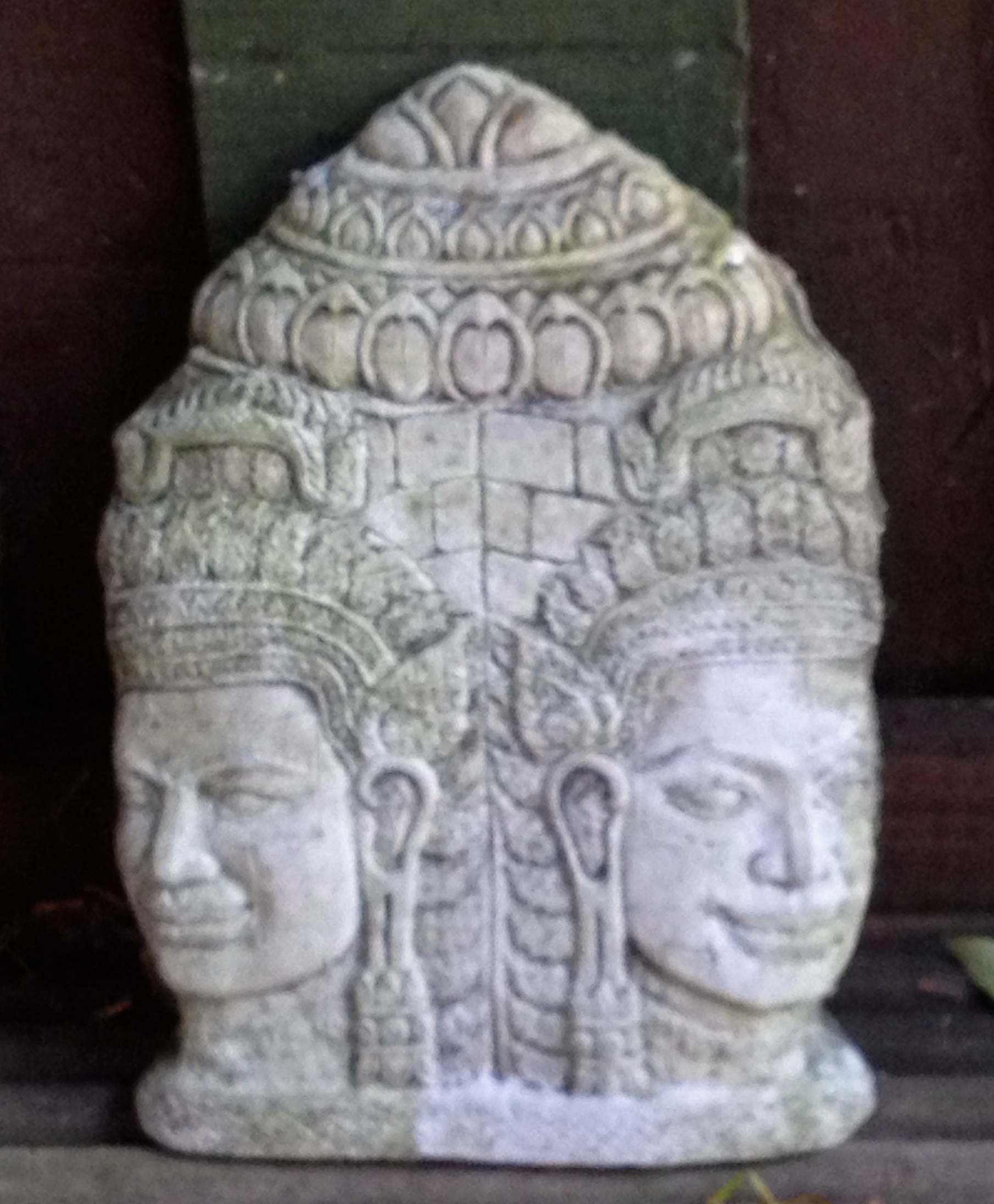
Agni: the two-faced fire god at the Mandala Ashram. He is the link between heaven and earth as messages to the gods can be conveyed by the medium of fire.
I can get angry. I don’t lash out; it’s a quiet anger. I feel the heat rise to my face and feelings of frustration well up in me. When I was at the Mandala ashram in Wales, run by disciples of Swami Satyananda, I asked Swami Krishnapremananda for advice. Here are his recommendations:
• If you can’t do anything about it, let it go. The past should be forgotten because it takes up your energy. Use fire and water ceremonies to release this energy. Write a letter to the person with whom you have issues; then burn it. Take a stone, hold it, imbue it with what you want to get rid of, then throw it in the river.
• Postures that involve prostrations are good for releasing anger. The bowing action is a surrendering to god, recognising that some things you just can’t change. One such posture is shashankasana, the hare pose. In this pose you go from an upright kneeling pose (inhaling and opening) into child’s pose with your arms outstretched (exhaling and surrendering). The head should be in line with the spine. In the final position, the forehead is touching the floor, signifying coming back to earth. Swami Krishnapremananda recommends pausing between the in and out breath and imagining the breath or prana rising from the base of the spine (muladhara chakra) to the third eye (ajna chakra). The Satyananda textbook Asana Pranayama Mudra Bandha (APMB) has a lovely description of the pose, explaining that shashank is Sanskrit for moon, from the words shash meaning ‘hare’ and ‘ank’ for lap. This is because the dark patches on the moon resemble a hare with the moon in its lap. “The moon symbolises peace and calm; it emits soothing and tranquilsing vibrations. Shashankasana has a similar calming and cooling effect,” according to APMB.
• Yoga Mudra is another posture involving prostration. In a seated position, preferably lotus or half lotus, the hands are behind the back, the finger and thumb of one hand circling the wrist of the other. “The hands represent the ‘doing’ nature,” said Swami Krishnapremananda, “and putting them behind the back represents surrendering.” You then exhale forward imagining the prana/breath going from the pelvic floor to the head, bringing the forehead to the ground; then inhale up.
• Bhramari pranayama, or humming bee breath, is a breathing exercise to calm the mind. It is also a form of pratyahara (sense withdrawal). In a seated position plug your ears with your middle index fingers. Have your lips slightly parted. Bring your attention to the centre of the forehead (ajna chakra). Inhale through the nose and exhale, making a deep, steady humming sound.
For further information on the poses and pranayama see APMB, published by Yoga Publications Trust.