
Yoga postures are not just about moving limbs and coordinating breath. Subtler dimensions exist like the chakras (energy points), nadis (energy lines) and koshas (different bodily layers). The course I did at the Mandala Ashram Wales, Embodying Insight, emphasised awareness of these deeper levels. This ashram teaches the Satyananda form of yoga.
Asana
More subtle awareness can be brought to the asanas by imagining the prana rising from muladhara (base chakra) to ajna (third eye chakra) as you inhale, and down from the ajna to the muladhara as you exhale. For further emphasis, you can pause between the inhalation and the exhalation and squeeze the muladhara root lock (the muscles you use when you want to stop urination) on the exhale. Positions which are particularly suited to this technique are:
- pranamasana (bowing pose) to ushtransana (camel)
- shashankasana (pose of the moon or hare pose)
- marajariasana (cat stretch pose)
- tadasana (mountain pose) — interlocking hands, inhaling up onto tiptoes raising arms, palms facing up and down again, palms facing down.
- yoga mudra
- prana mudra.
Awareness of ajna chakra can also be added to natarajasana (lord of the dance pose) and awareness of breathing through the nostril on the side of the body you are twisting on in ardha matsyendrasana (half spinal twist). For further information on the postures, see Asana Pranayama Mudra Bandha by Swami Satyananda.
Makka ho exercises
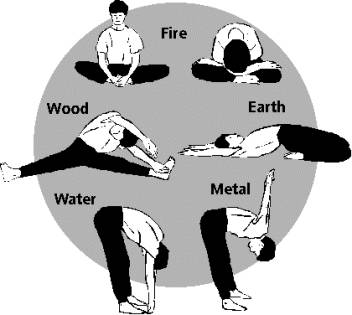
Makko-ho : Far-east meets Near-east
These exercises are supposed to stimulate the meridians in Traditional Chinese medicine. They can be done relatively quickly (three or five complete breaths in each position) as a morning practice, according to Swami Krishnapremananda, a resident swami at the ashram. Most correspond to traditional yoga postures.
- Air/Metal: Lung & large intestines (Dwikonasana). Thumbs are clasped, sides of index fingers touching. Other fingers spread. Standing, stretch arms upwards. Then arms behind and downwards, chest open. Finally, bend forward.
- Earth: Stomach & spleen (Supta Vajrasana)
- Fire: Heart & small intestines (Poorna titali asana). In this position, try to keep the spine straight. Elbows bent and out to the side.
- Water: Bladder & kidney (Pashimottanasana)
- Fire: Heart constrictor & triple heater (Yogamudasana variation). Ankles are in front of pelvis, arms crossed to create pressure on lower sternum. Spine long, tip forward over hips. First left leg and arm inside, then right leg and arm inside.
- Space/Ether/Wood: Gall bladder & liver (Parvirttajanusirasana)
Pranayama
Buddha in the grounds of Mandala Ashram
Pranayama is a way of getting in touch with the pranic body. Swami Krishnapremananda described it as “enabling us to open up to insights beyond rational”. We did the usual forms of bhastrika (bellows breath), nadi shodana (alternate nostril breathing) and kaphalabhati (shining skull). However, anuloma viloma (which means up and down) and prana shuddhi (lifeforce cleansing) were different to the forms of pranayama I’d done before. In some schools of yoga, anuloma viloma is the same as nadi shodhana. However, in the Satyananda school it is different. Thus follows a brief explanation of the practice: Anuloma viloma: imagine the breath going in the left nostril to the eyebrow centre and out of the right nostril, then in the right nostril and out the left. Continue for five rounds. Prana shuddhi: after five rounds of anuloma viloma, breath in through both nostrils, holding at the eyebrow centre, and then breath out again.
Chakrashuddi
Chakrashuddhi means cleansing the chakras. It’s rather like a Reiki technique, moving your hands over your body, cleansing the pranic field which expands to 12 finger-widths away from the body, according to Swami Krishnapremananda. You can do it quite fast once you’re familiar with it. It then looks a bit like a tai chi exercise. The technique is as follows:
- Stand with your hands crossed, palms facing your heart. Legs lightly bent.
- Move your hands out from the heart to a couple inches away from your body.
- Bring hands up and over your head to a couple of inches away from the back of your head.
- Bring them forward to a couple of inches in front of your face, then back down towards the heart.
- Move the hands down and behind the body to a couple inches in front of the lower back.
- Move the hands down the backs of the legs, a couple of inches away.
- Bring hands forward to a couple of inches above the front and inner parts of the legs.
- Move hands a couple of inches over the belly.
- Move hands back to the heart again.
Exercise from a Tantric Priest
Chakrashuddhi is rather like an exercise I learnt from a tantric priest (Krishnan Namboodiri) in the Sivananda ashram in the Bahamas. This exercise reminds me of the Sivananda arati, where at the end of a puja (act of worship) a lighted lamp is waved, signifiying the dispelling of the darkness. The worshippers then hold up their hands to take in the lamp’s light, and then they pass the light over their face and body. Here’s Krishnan’s recommendation for what he calls ‘self-attunement’.
- Light a candle and chant three oms very slowly.
- Focus on the candle flame.
- Place your hands over the candle flame, seeing it as a sun and taking in the energy from it.
- Move your hands over your body, breaking it down into ten parts:
- face
- head
- neck
- whole body
- legs
- feet (separate)
- hands
- arms
- shoulders
- back.
Yoga Nidra
Yoga nidra, (or yogic sleep, which was popularised by the Satyananda school) is one way of bringing more awareness of the chakras and koshas into your practice. The Bihar School of Yoga book Yoga Nidra contains transcripts, plus you can listen to a chakra yoga nidra on the Mandala Ashram website as well as download a transcript of a kosha-based yoga nidra. I particularly like the the kosha yoga nidra as it involves awareness of the two parts of the mind: witnessing and thinking.