
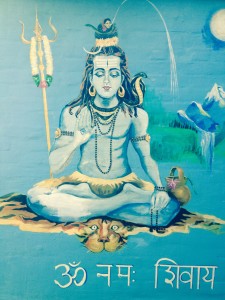
Siva at the London Sivananda Centre
I went to a yoga workshop at the London Sivananda Centre on the Alexander Technique and Sivananda Yoga, given by Sita from the Hamburg centre. I’ve always been a bit over-awed by Sita. She’s a slim blonde with an impressive bone structure; her manner is compassionate, but firm. She has that mix of charisma and knowledge that makes an excellent teacher. During the workshop she gave us an overview of the Alexander Technique, telling us how teachers can use it when explaining yoga postures and adjusting students.
The Alexander Technique and Sivananda Yoga make good partners. The Alexander Technique is about improving posture, which is important in the west with our chair- and computer-bound lives. Many people sit with their back slumped, shoulders hunched, head thrown back. The Alexander technique rectifies this by keeping the relationship between the head, neck and torso (called primary control) harmonious. Basically, the head should move up and forward, so that the spine lengthens and the back widens. The results are not only physical but mental as well: space is increased between the vertebrae, giving more room to the blood vessels, which can then provide more blood to the brain, aiding its activities.
Here is a list of the general points I learnt from the workshop:
• Remind students to keep their spine long, back wide, shoulders relaxed, neck free and head slightly forward.
• End-gaining – this is focusing on what you want rather than the method of getting there. Students do this trying to get into positions. For example, a student might focus on achieving the full headstand too soon, rather than trying to do each stage correctly.
• The teacher should pay attention to their own posture while adjusting students.
• Lying in semi-supine. This could be an alternative to corpse position at the end of a class. In this position the head is supported forward and up by books or a cushion. The feet are shoulder-width apart and the knees are bent, thus taking the pressure off the lower back. Arms are either by the side of the body, palms facing down, or elbows are resting on the floor, hands facing down. While in this position the teacher can give the following instructions as autosuggestion.
- I allow myself to do nothing. I leave myself alone. My breath re-connects me with my body.
- My feet are supported by the ground.
- My pelvis is supported by the ground.
- My lower back is supported by the ground.
- My middle back is supported by the ground.
- My upper back is supported by the ground.
- My hands are supported by my body.
- My upper arms are supported by the ground.
- My head is supported by the book.
- I leave myself alone.