
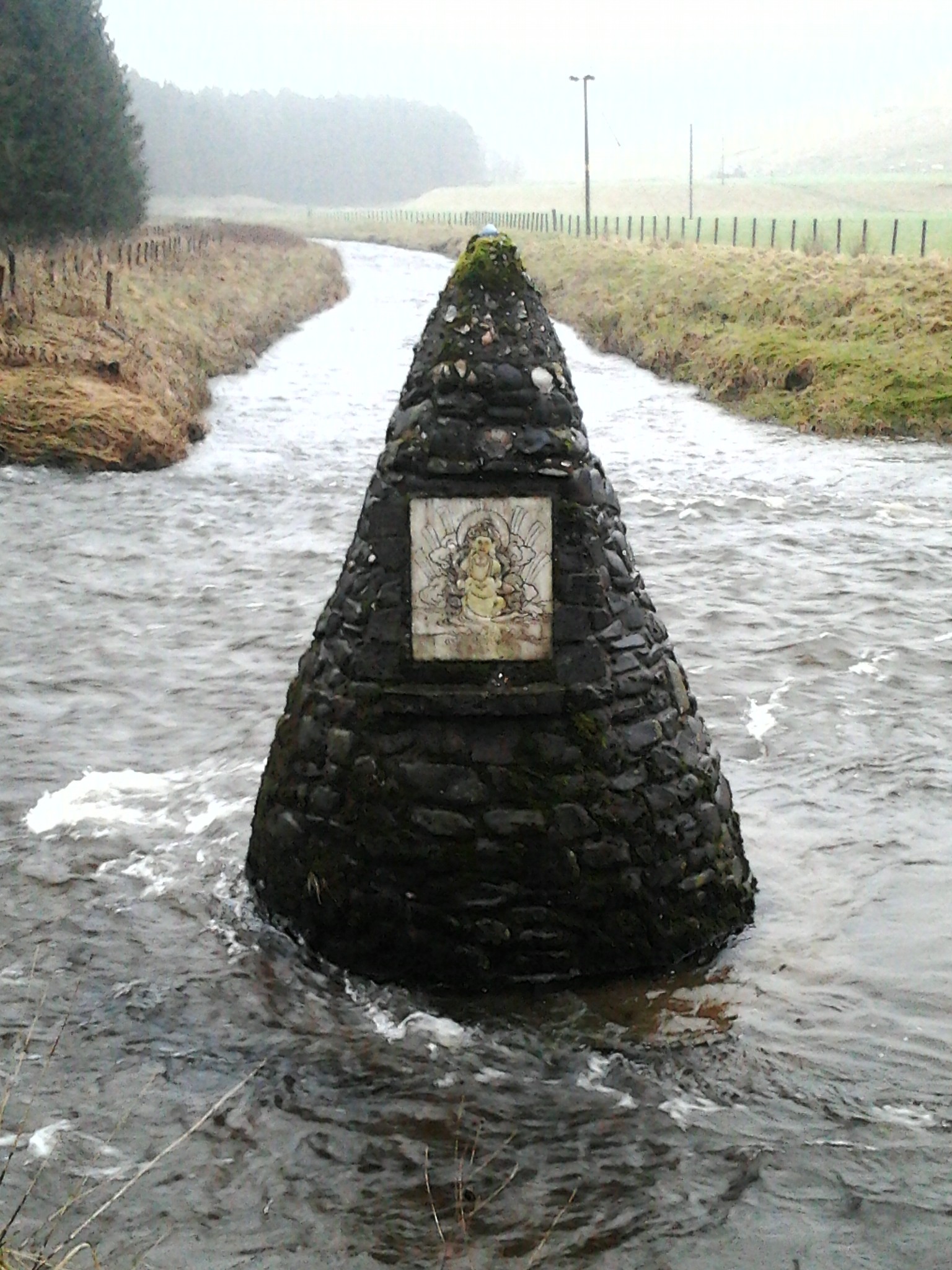


Statue of Tara in the Medicine Garden
I spent Christmas and New Year at Kagyu Samye Ling, a Tibetan Buddhist monastery on the west coast of Scotland near Lockerbie. It was very laid-back for a monastery. No six o’clock roll calls, compulsory meditation or lights out at 10. There weren’t even that many monks or nuns around (apparently most of them were on a four-year retreat – women on Holy Isle, men on Arran). You could pretty much come and go as you pleased, as long as you didn’t drink or indulge in any obvious sexual misconduct. There was even a cafe where you could sip lattes till 10 o’clock at night.
The monastery has an interesting history. It was originally a hunting lodge called Johnstone House and became the first Tibetan Buddhist centre in Europe in the 1960s. Initially, it was run by Tibetan refugees Akong Rinpoche and the controversial and charismatic Chogyam Trungpa, both of whom were in their 20s. Chogyam Trungpa was famous as much for his clarity of teachings as he was for drinking and womanising. Apparently, during his residence at Samye Ling (1967-1970), there were wild parties and David Bowie and Leonard Cohen were visitors. However, when Trungpa left for America in 1970 (where he died of alcoholism in 1986), Akong cleaned the place up (I imagine him driving down to the tip with all Chogyam’s empties) and turned it properly into a monastery with his brother, Lama Yeshe, as abbot.
Today, as well as the lodge and other accommodation buildings, there’s a temple, butter lamp house, stupa, and various exotic golden statues looking rather incongruous in the damp Scottish landscape. (It was incredibly rainy the ten days I was there, a non-stop drizzle which resulted in a layer of moss, inches deep, on the trees).

Moss!
Samye Ling is good value: I paid £24 a night for a bunk bed in a six-person dorm (basic but warm) and all the food I could eat, plus a limitless supply of tea. The food was excellent (mind you, I’ve been a vegetarian for 20 years and never once craved meat), with an ex-monk and trained chef in charge. Breakfast was porridge with various toppings, plus toast and fruit. Lunch was the main meal, with about 10 different dishes on offer: a couple of main protein dishes, as well as a variety of vegetables, salad and rice. Plus there was always a hearty pudding as insulation against the Caledonian chill. Dinner was soup.
While I was staying there, the day began at 6.00 with Tara prayers. I confess I never made this, instead clambering down from my top bunk at around 7.00 for breakfast. Silent meditation was from 8.00-9.00. After meditation, I would roll my yoga mat out in the small room at the back of the temple and do half an hour’s practice, as this was the only opportunity I got to burn off the calories accrued from eating a large helping of the sticky toffee pudding the day before. (Going for a walk was impossible: I’d get drenched in 10 minutes and the wind would sting my ears). From 9.45-12.30 (including breaks) I’d do a meditation course. From 12.30 to 3.00 was lunch and free time. From 3.00 to 4.15 was more meditation course, and from 5.00 to 6.00 was a guided meditation. At 6.00 we had soup (in strict Buddhist monasteries, there’s not supposed to be any eating after midday). 7.00-7.45 was Chenrezig prayers. (Chenrezig is the Tibetan god of compassion). At 7.45 we went out to the butter lamp house to light 1,000 lamps for world peace. I don’t know what it is exactly, maybe I have a bit of pyromaniac inside me, but lighting lots of tealights and chanting om mani padme hung was really fun. From 8.00 to 10.00 I’d sip tea on the big sofas in lounge in Johnstone House and chat to whomever happened to be hanging out there.
Despite the relaxed atmosphere, everyone appeared to behave themselves and not break any of the five precepts. Some people were serious Buddhists, others not at all, just wanting to learn more about meditation or, as one woman told me, “go somewhere where I can get away from Christmas”. I felt rested and happy after my 10 days there, with new friends, a new knowledge of Tibetan tantra practices, and suitcase heavy with books and incense I couldn’t really afford.
Personally, I nearly always prefer to do yoga and meditation at an ashram or a monastery. They’re nearly always cheaper than a private establishment, and if you are going somewhere with a respected lineage (Sivananda or the Kagyu school of Tibetan Buddhism), the teachers are normally top-notch. Plus, as they are all charities, run mainly by volunteers or monks and nuns who’ve taken vows of poverty, all the money you give them goes to keeping the establishment running or other good causes.