

The next day I’m shown to my bed in the permanent women’s dorm. The beds are arranged in twos with plenty of storage space, plus an electrical point. On the downside, there’s no hot water; seasoned visitors know to bring travel kettles and large heating elements to stick into buckets. On the whole, the ashram is small and basic with few distractions, which is what’s needed for such an intensive course. It’s only been open since 2006 and is still very much a work in progress. The grounds are gradually being landscaped, and already the dorms are flanked by tamarind, jackfruit and mango trees, which are pillaged by small, silver-furred monkeys. A large hall is being built by men with dhotis tucked between their legs and no hard hats; the temple, dedicated to Kali as the priest says that’s the energy of the place, has only just been inaugurated.
There are around 40 people on the course, about half are Indian, the rest Western with a few Asians. It’s roughly a 50/50 male/female split too, probably because yoga isn’t seen as a mainly female pastime in India, but part of the spiritual heritage. The course is run by Prahlada, a disciple of Swami Vishnudevananda from the age of 17 who runs the Sivananda centre in Toronto. He has a lively, earthy, charisma, always cracking jokes during our meetings — just what you need in such demanding course.
The Sadhana intensive is about self-practice. At one of the daily meetings we’re given a list of
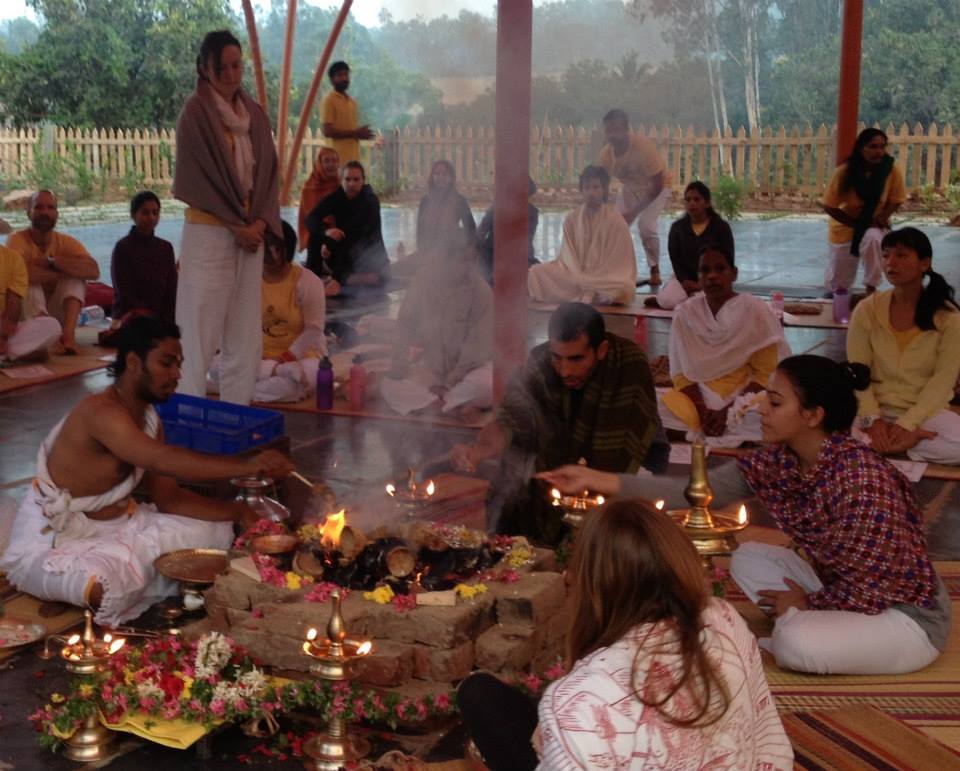
Puja in the Kali temple
various pranayamas; then we have to complete them in our own time in the large palm-leafed hut. It starts off very gently: 40 minutes of asanas, then three rounds of kaphalabhati and 10 rounds of auloma viloma. At the end we read 10 verses of Shankara’s Crest Jewel of Discrimination. Everyone is focussed on their own practice, but encouraged by those around them.
The course participants keep to the same timetable as the normal ashram: with satsangs at 6.00 a.m. and 8.00 p.m., plus meals at 10.00 and 6.00. Our food is different though: no salt or other spices are added as too much sensory input can disturb the practice. I mainly eat a soupy kitchari, plus boiled vegetables. As a treat we are given rice pudding in the afternoon — the sweet taste is said to increase feelings of devotion.
As the course progresses the practices get tougher. This is my practice schedule from the end of the course. It takes over three hours and I have to do it three times a day.
- relaxation
- prayer
- relaxation
- 3 x kaphalabhati with bandhas
- 40 x nadi shodana with bandhas
- 10 x samanu
- 10 x surya bheda with bandhas
- 10 x ujjayi with bandhas
- 10 x sitali no bandhas
- 3 x bhastrika with bandhas
- 10 x brahmari no bandhas
- 10 x mahamudra
- 10 x mahabandha
- 10 x mahaveda
- 1 x shakti chalana mudra
- relaxation
- prayers
I find the nadi shodana the most challenging: 40 rounds with bandhas comes to nearly an hour. Also the end mudras, which involve hitting the perineum with heel, are so painful that they’re nearly impossible (maybe it’s a female thing). Sitting cross-legged is also an endurance feat: I have to take breaks every hour because my back hurts and my legs have gone numb.
Some people attending this course have deep spiritual experiences. A friend of mine said she felt her heart chakra open, while another became so hot that she jumped fully clothed into the swimming pool at the Val Morin ashram. (Feelings of heat are said to be the first sign of kundalini rising). This doesn’t happen to me, probably because my practice isn’t strong enough to begin with. However, I take with me a greater understanding of pranayama and a sense of the importance of tapas: self-discipline that generates internal heat. We were told to read the Srimad Bhagavatam in our spare time (the Kamala Subramanian version, which is written with narrative flair and surprisingly readable). It’s a devotional text, relating stories about the various incarnations of Vishnu. What strikes me when reading it is the emphasis on tapas. It doesn’t seem to matter whether someone is good or bad, if they develop cultivate enough tapas the gods reward them. However, because the evil characters’ intentions are not pure, they eventually suffer a downfall. So this is what I need in my life: more spiritual discipline. Perhaps then I’ll see some progress.