
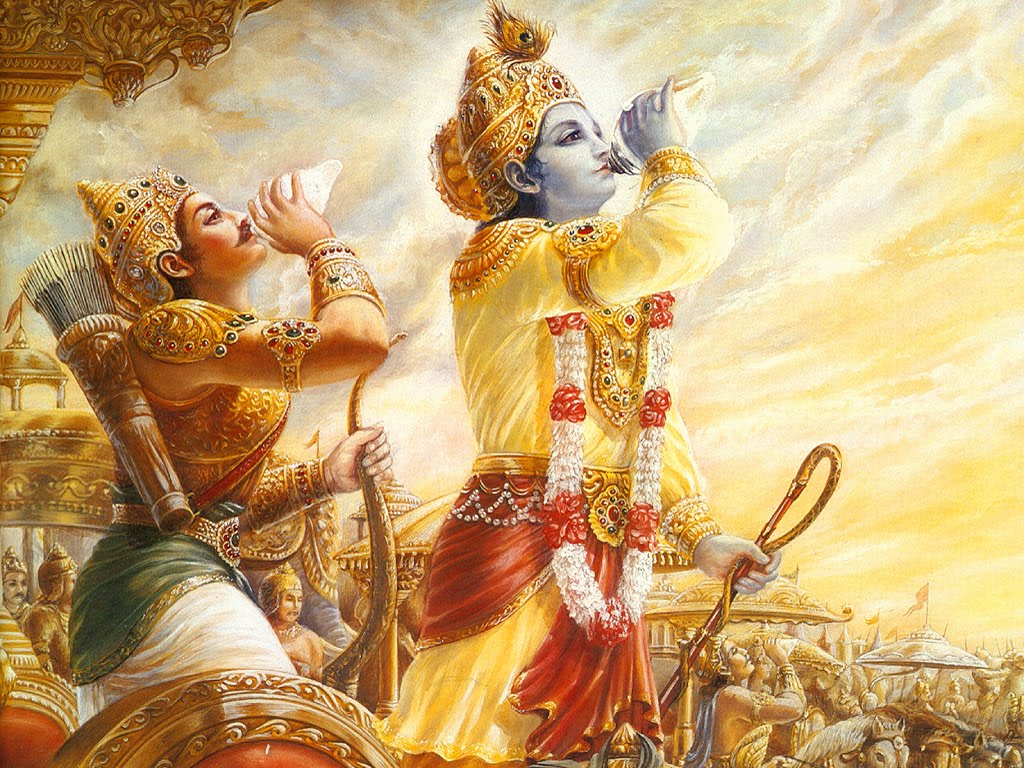
I’m reading my third translation of the Bhagavad Gita. I started some years ago with the Juan Mascaro version in Penguin. The language was beautiful, but probably not very accurate. Then I read Jack Hawley’s version, which is easy to understand, but certainly not poetry. Now I’m reading Swami Sivananda’s version. The language is somewhat archaic, e.g. “Whence is this perilous strait come upon thee…” but it does have a commentary with every verse, something that the others don’t have and which makes the Sivananda version at least three times as long. (So it’s taking me a while to get through).
I feel it’s a good time to be reading the Gita. Like so many people I’m in a bit of a in-between stage workwise. One job has finished, and I’m about to decide on the next phase of my life. Like Arjuna standing on the battlefield of life, I’m not feeling too confident or sure about what I should do next. However, I get some reassurance from Krishna’s advice in verse 2:47: “Thy right is to work only, but never with its fruits; let not the fruits of action be thy motive, nor let thy attachment be to inaction.”
What Krishna is saying, I believe, is that in life we should do our duty or work, but we have no ownership of any success (or even failure) that results. Furthermore, he says it is wrong to avoid work. (“nor let thy attachment be to inaction.)
So I should just get on with things and concentrate on the task in hand. It’s a huge relief for me not to have to worry about whether it is successful or not. And if I don’t own the success or failure of my work, then it certainly can’t define me or be part of my personality.
You have nice blog….. hope you soon will see some beautiful post from you…..:)
This is intense stuff!! I actually miss practising yoga, myself. I’ve moved town & there’s nowhere close. It’s great. But never heard of yoga philosophy before.
If you lived in Dorset I’d teach you!
Hello Swati yoga,
I stumbled upon your blog while i was searching for blogs related to Srimad Bhagavad Gita.
Well, outta curiosity, wanted to ask if you had read Srimad Bhagavad Gita by His Divine Grace A.C. Bhaktivedanta Swami Srila Prabhupada ?
You may want read it, cos it provides more insight into the spiritual science of the Supreme Lord.
Regards,
Acyuta
Hi Acyuta
Thank you for reading my post. I am aware of this version of the Bhagavad Gita. It’s the Hari Krishna one. I used to like going to the Hari Krishna temple in Soho when I lived in London. I really liked the cafe there — delicious and cheap vegetarian food. I haven’t read it yet, but will make a note to do so.
Regards
Swati