
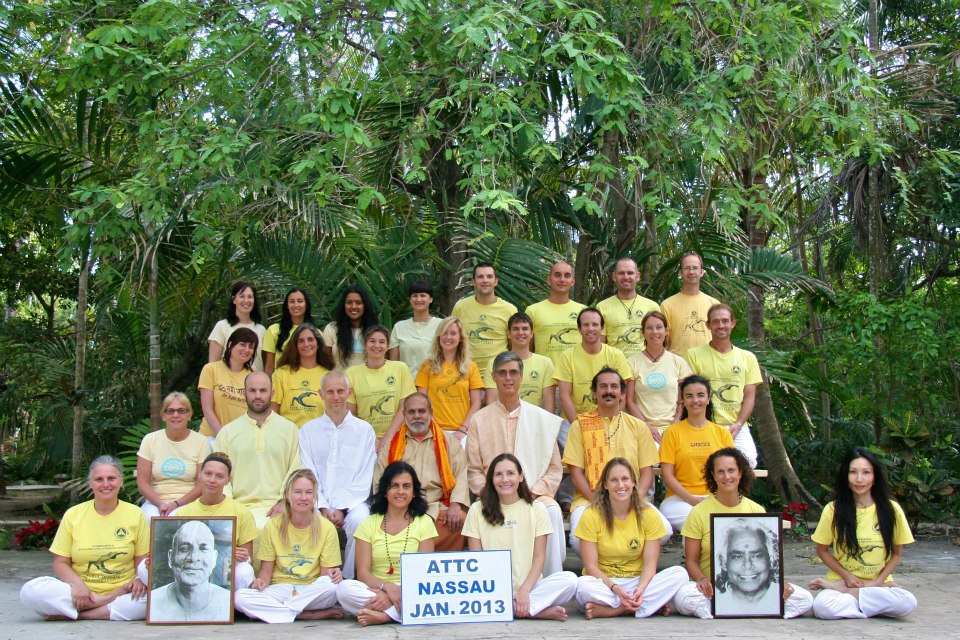
The Sivananda ATTC (advanced teacher training course) is not the most practical of yoga courses in terms of teaching. Okay, so you learn how to do some of the more advanced asanas, but that’s about it. The rest of the time you are trying to embed the sanskrit alphabet in your brain (finding funny aide-memoires for all the characters), memorising raja yoga sanskrit terms, sketching diagrams of the different parts of a nerve for anatomy and physiology, getting up at 4.30 to do pranayama before satsang. (You were told not to teach or, in fact do, hardly any of the pranayamas away from the ashram — “we don’t want you raising the kundalini on your own!”).
But what it gives you is an experience. I did a class-room (or should I say yoga-studio-based) yoga foundation course ten years ago. (It was at Yoga Junction in London with Tara Fraser). The teaching was excellent, and it really deepened my knowledge of yoga. However, having to adhere to ashram regulations and being taught by Hindu monks for a month is very profound. In my experience, most yoga teachers cannot offer the spiritual instruction that the swamis can.
It’s a real event, leaving your life for a month and jetting off to an ashram, which is usually in a spectacular place: the snow covered mountains of Austria, the chalky sands and turquoise waters of the Bahamas, and the lush coconut and rubber trees of Kerala. The teaching courses are, for the most part, taught by swamis and brahamacharyas — people who have dedicated their lives to yoga, and usually there’s other visiting experts to give talks on topics such as nutrition, vedic astrology and yoga philosophy, or conduct Hindu rituals.
I never knew I could survive on so little sleep until I did the Sivananda ATTC. I went to bed around 10.30, fairly swiftly after satsang had finished, and got up at 4.15 for a shower and neti (nasal passage cleansing) before heading to the yoga platform at 4.45 to limber up before pranayama at 5.00. Pranayama, which lasted for an hour, started with Kaphalabhati (shining skull breath) and anuloma viloma (alternate nostril breathing). The latter was especially challenging, as it we ended up having to hold it for a count of 8:32:16. Then we did the more advanced pranayamas. Firstly the heating ones: surya bheda — breathing in through the right nostril; ujjayi – constricting the throat make an ‘ocean sound’; bhastrika, or bellows breath – short, sharp inhalations and exhalations. To cool down, we did sitkari – breathed in through the teeth. And finally, to get us prepared for meditation, we did bhramari, or bee breath – inhaling and exhaling making a bee sound.
At 6.00 was satsang, which was the usual 30 minutes meditation, followed by chanting and a talk or music. At 8.00 we had a (short) asana class, followed by anatomy and physiology, (which focussed a lot on the nervous system) at 9.00. Breakfast/lunch was at 10.00 and classes started again at midday with either raja yoga (studying Patanjali’s Yoga Sutras) or sanskrit. Study of Vedanta was at 2.30, then an hour later, a two hour asana class. Dinner was at 6.00, and the day ended with satsang again at 8.00. Any spare time I had was either spent doing karma yoga (45 minutes compulsory — I did laundry) or homework/revision. I had so little time to my self, that I had to postpone shaving my armpits and legs until my day off.

Ladies in Yellow and White: Graduation Night
Most yoga teaching course pass you if you just attend the required amount of hours. (During the ATTC, someone took the register at the start and end of every class). However, with Sivananda you also have to do a three-hour exam, and you need to get 50% in every section to pass. I don’t know for sure, but I believe about four of the people doing the ATTC failed. Being in the Bahamas is a big distraction — it’s too easy to spend time on the beach, or to head down to the spa/Starbucks in Atlantis. The people running the course were constantly having to discipline the class, usually for lateness or inappropriate clothing. (It’s not on to look sexy in an ashram — skin-tight leggings and low-cut tops are out).
Despite the name, the ATTC course is more about self-development rather than advancing your teaching. The Sivananda organisation is not really into you making money — yoga is more about seva: selfless service. I would like to do another course to improve my teaching; this time focussing more on anatomy and physiology directly relevant to the asanas as well as describing and adjusting poses in class. In the ATTC it’s the philosophy that’s important: getting good marks in the vedanta and raja yoga parts of exam is imperative, and after completing the course I can see why. Often in the Western world we isolate meditation and asana from their original context. In the eight limbs of raja yoga, asana is third and meditation seventh. Before embarking on them, in my understanding, you were supposed to work on limbs one and two, your moral conduct: the yamas (don’ts) and niyamas (do’s). From my experience of Tibetan Buddhist meditation the same holds true: the lama would tell me that being compassionate is far more important than meditating every day, and Buddhists are supposed to adhere to the eightfold path. It’s an interesting point, which you rarely hear at most yoga and meditation classes: can you really make any progress in asana or meditation if you don’t address your ethical behaviour first?
The ATTC in the Bahamas costs around $2,400 for a tent and $3,290 for a dorm/tent hut. It’s good value as this is comparable to cost of studio-based course, but without the food and board.
Very interesting account Swatiyoga…! 🙂 <3
Thanks Mike. Cx